Introduction: Why Quantum Matters Now
Stock exchanges, clearing houses (CCPs), and central securities depositories (CSDs) occupy a unique position in the financial ecosystem. Unlike commercial banks or trading firms, they are not just participants—they are system orchestrators, responsible for:
- Trade execution
- Clearing and settlement
- Risk management and margining
- Market integrity and resilience
Quantum computing introduces a profound shift for these institutions. It is not simply another technology wave. It is a fundamental disruption of the assumptions that underpin trust, security, and efficiency in financial markets.
For market infrastructure players, this disruption has two faces:
- A systemic risk that could undermine core operations
- A generational opportunity to dramatically improve efficiency and competitiveness
Understanding—and acting on—both dimensions is now a strategic imperative.
The Risk: When Trust in Infrastructure Becomes Fragile
1. Cryptography: The Invisible Foundation at Risk
Modern financial markets rely heavily on public-key cryptography (primarily RSA and ECC) to secure:
- Trade confirmations
- Settlement instructions
- Secure communications
- Software integrity
Quantum computing threatens to break these systems.
A sufficiently powerful quantum computer could:
- Forge digital signatures
- Decrypt sensitive communications
- Impersonate system participants
For market infrastructure companies, the implications are severe. These organizations depend on deterministic finality—the guarantee that once a trade is settled, it is final and irrevocable.
If cryptographic integrity fails, finality itself becomes questionable.
2. Settlement Systems: A Single Point of Systemic Failure
CSDs and CCPs operate delivery-versus-payment (DvP) and clearing systems that process trillions in daily transactions.
A quantum-enabled adversary could:
- Manipulate settlement messages
- Alter asset ownership records mid-process
- Inject fraudulent instructions into clearing workflows
This is not a localized risk. Because these systems sit at the center of the financial network, any compromise would have system-wide repercussions.
The result would not be a typical “cyber incident”—it would be a crisis of market confidence.
3. The Code-Signing Vulnerability
Market infrastructure operators continuously update:
- Matching engines
- Risk models
- Trading interfaces
These updates are authenticated using cryptographic signatures.
If these signatures are compromised:
- Malicious code could be distributed system-wide
- Trading logic could be manipulated
- Markets could be destabilized intentionally
The potential outcomes range from flash crashes to coordinated disruptions across multiple markets.
4. “Harvest Now, Decrypt Later”
One of the most immediate risks is already underway.
Adversaries are capturing encrypted data today, including:
- Order book dynamics
- Trade routing patterns
- Institutional strategies
When quantum capabilities become available, this data can be decrypted retroactively.
For market infrastructure firms, this means:
- Historical confidentiality is no longer guaranteed
- Clients’ proprietary strategies may be exposed
- Trust in the neutrality and confidentiality of the platform erodes
The Opportunity: Reimagining Efficiency at Scale
Despite these risks, quantum computing also offers transformative benefits—particularly in areas where market infrastructure firms face extreme computational complexity.
1. Clearing and Netting Optimization
Clearing houses solve massive combinatorial optimization problems daily:
- Millions of trades
- Thousands of counterparties
- Multiple asset classes
The objective is to minimize the amount of cash and collateral required while preserving risk integrity.
Today’s systems rely on approximations. True global optimization is often computationally infeasible.
Quantum algorithms—and even quantum-inspired classical techniques—can:
- Identify optimal netting structures
- Minimize liquidity requirements
- Reduce collateral demands
The impact is enormous: billions in capital could be freed for market participants.
This shifts clearing houses from being capital consumers to capital efficiency enablers.
2. Real-Time Risk and Margining
Risk management in CCPs relies heavily on:
- Value-at-Risk (VaR)
- Stress testing
- Scenario analysis
These calculations are computationally intensive and often performed in batch processes.
Quantum techniques, such as Quantum Amplitude Estimation (QAE), can:
- Accelerate Monte Carlo simulations
- Improve accuracy of tail-risk estimation
- Enable real-time risk monitoring
This opens the door to:
- Continuous margin recalibration
- Faster detection of systemic stress
- Prevention of cascading defaults
In essence, risk management becomes predictive rather than reactive.
3. Competitive Dynamics: A New Source of Differentiation
Market infrastructure has traditionally been viewed as a utility business.
Quantum changes that.
Early adopters can:
- Offer lower margin requirements
- Provide superior capital efficiency
- Attract higher trading volumes
This creates a new competitive axis:
Efficiency, not just reliability, becomes the differentiator
The first infrastructures to operationalize these capabilities will gain a structural advantage.
The Timeline: Why Action Cannot Wait
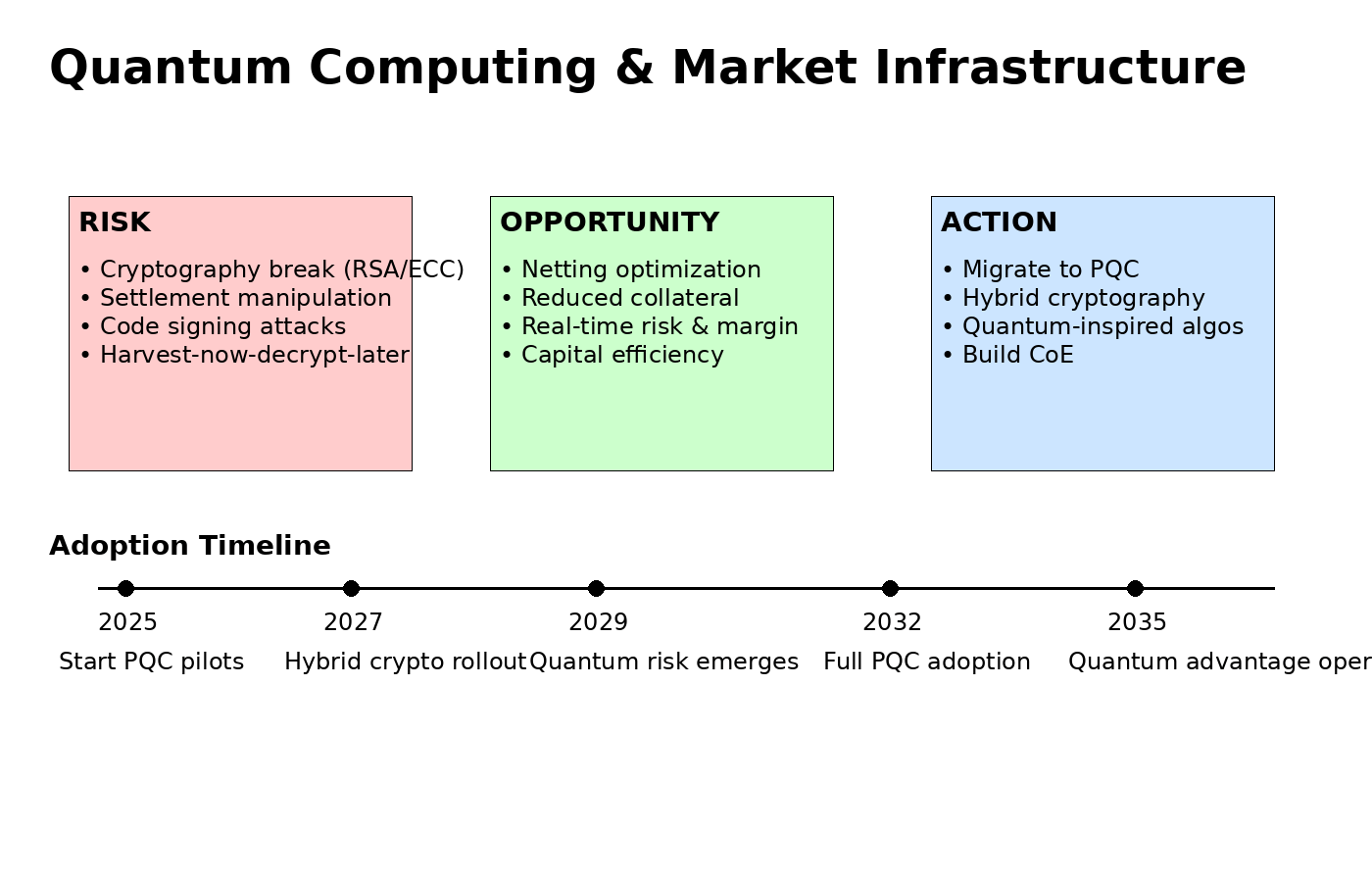
Estimates for cryptographically relevant quantum computing (CRQC) suggest potential viability between 2029 and 2032.
However, the transition timeline for financial infrastructure is long:
- System redesign: 3–5 years
- Industry coordination: 5–10 years
- Regulatory alignment: ongoing
This creates a critical insight:
The transition must begin before the threat materializes—not after.
Waiting until quantum capabilities are fully realized means acting too late.
The Strategic Imperative: A Dual-Track Approach
Market infrastructure companies must act on two parallel tracks:
1. Defend the Core: Build Quantum-Safe Systems
- Transition to Post-Quantum Cryptography (PQC)
- Standards such as ML-KEM and ML-DSA
- Adopt crypto-agility architectures
- Secure APIs, messaging systems, and code-signing processes
- Prioritize systems with long-lived data sensitivity
2. Capture the Upside: Deploy Advanced Optimization
- Implement quantum-inspired algorithms today
- Focus on:
- Netting and clearing
- Collateral allocation
- Risk simulations
These initiatives deliver immediate ROI while preparing for future quantum integration.
3. Lead, Don’t Follow
Infrastructure providers should:
- Establish dedicated quantum programs or centers of excellence
- Partner with academia, vendors, and regulators
- Shape industry standards instead of reacting to them
The goal is clear:
Transition from quantum-vulnerable to quantum-advantaged
Conclusion: Redefining Market Infrastructure for the Quantum Era
Quantum computing will not merely upgrade financial systems—it will redefine their foundations.
For market infrastructure companies, the stakes are uniquely high:
- They are guardians of trust
- Anchors of systemic stability
- Enablers of global capital flow
The institutions that succeed will be those that recognize the dual nature of this shift:
- Protect trust through quantum-safe security
- Unlock efficiency through quantum-driven optimization
Those that do both will not only survive the transition—they will define the next generation of global market infrastructure.
The quantum era is not a distant horizon. For market infrastructure, it has already begun.